Red Monastery
A fifth-century monastic church near Sohag holding the most complete late antique painted interior in Egypt.
Updated 19 October 2026
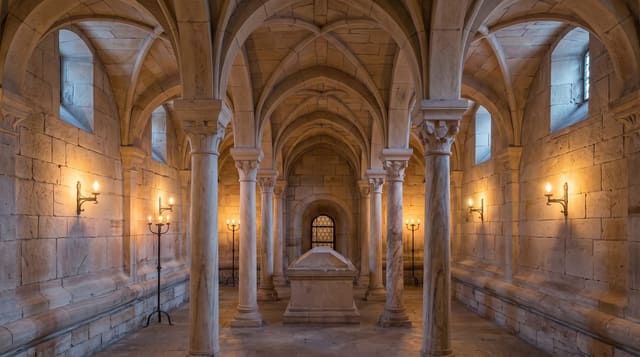
Deir al-Ahmar takes its name from the red brick it is built of, in contrast to the limestone of the White Monastery nearby, and it holds something quite rare. Its triconch sanctuary retains almost its full scheme of late antique wall painting, layer upon layer from the fifth to the seventh century, and a long conservation programme completed in recent years removed centuries of soot and overpaint to reveal saints, prophets, architectural illusionism and dense ornament in strong reds, yellows and greens across every surface, including painted niches and columns. Nothing else in Egypt gives such a complete picture of how a church of this date actually looked. The rest of the monastery was largely lost, so the church stands within a modern compound and a working community.
History
Almost nothing is recorded of the Red Monastery's foundation: it is thought to have been founded by the Egyptian saint Pshoi, or Pishay, a contemporary of Pigol, founder of the nearby White Monastery, and the building most likely dates from the same period, probably the 5th century. Besa's Life of Shenoute mentions an Apa Psoi walking with Pigol and the young Shenoute, which is taken as a reference to this monastery. It owes its name to the red burnt brick of its outer walls, which are much thicker at the base than at the top and are crowned with cavetto mouldings like those of Pharaonic temples. The 15th-century historian al-Maqrizi names the monastery but gives none of its history, probably because it was so closely tied to the White Monastery, and Vivant Denon, who passed in 1798-99, found it ransacked and burned a few days earlier. Only a few monks live here today, and the church still serves the Coptic villages around it and the pilgrims who come for the great feasts (Wikipedia, Red Monastery).
What's there
- A fully painted triconch sanctuary - the most complete late antique interior in Egypt.
- Conserved colour - reds, yellows and greens recovered from under soot.
- Painted architectural illusionism - false columns and cornices on flat wall.
- Red brick construction - the fabric that gives the monastery its name.
When to go
October to April. Two hours, paired with the White Monastery. The interior is dim and midday gives the best natural light, though the conservation lighting helps. Visitors are rare.
Before you go
Access to the painted sanctuary depends on a monk or guardian being available and it is sometimes closed. Photography is generally not allowed inside. Modest dress required. The surrounding modern buildings are unattractive. Regional escort arrangements may apply.
Nearby
The White Monastery is a short drive south; Sohag is east on the river.
Key facts
Source: Wikidata, item Q7304611, read on 18 October 2026.
What to pack for Red Monastery
Chosen from what this place is for. Tap a kit for the full checklist.
- Comfortable walking shoes - Sightseeing means kilometres of pavement and cobbles daily. Find on Amazon
- Modest clothing - Shoulders and knees covered - the single most common requirement. Find on Amazon
- A slim anti-theft daypack - Zips that close properly; keep it in front in crowds and on transit. Find on Amazon
- A scarf or shawl - To cover the head or shoulders on entry; women especially at mosques. Find on Amazon
Some links on this page are Amazon affiliate links - if you buy through them we may earn a small commission at no extra cost to you.
All packing kitsPlan your trip
Where to start if Red Monastery is going on the list.
Booking links on this page are affiliate links - if you book through them we may earn a small commission at no extra cost to you. It never changes what we write about a place.
Opening times, ticket prices and seasonal closures change - check the official source before you go: official site.