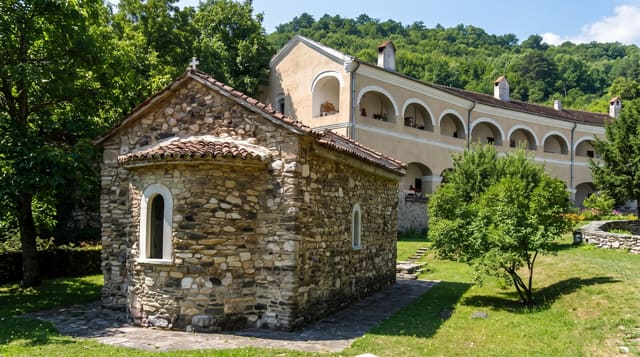
Esrum Abbey
The surviving wing of a great Cistercian abbey by Lake Esrum, with a working watermill and a medieval herb garden.
Updated 19 October 2026
Esrum was founded in 1151 and became one of the wealthiest Cistercian houses in Scandinavia, with vast landholdings across Zealand and daughter houses as far as the Baltic coast. After the Reformation it was dissolved and the buildings were pulled down for materials, largely to build Kronborg, leaving one wing of the monastic complex standing. That wing now holds exhibitions on Cistercian life and the abbey's role in the medieval economy, with the foundations of the great church marked out in the grass beside it. In the grounds are a reconstructed medieval herb garden, a working watermill on the stream, and the visitor centre for the Esrum Lake and Gribskov nature area, with a brewery producing beer to a monastic recipe.
History
Esrum began as a Benedictine foundation, perhaps around 1140, near a pre-Christian holy spring, and in 1151 the Cistercians took it over with the approval of Archbishop Eskil of Lund, as a daughter house of Clairvaux; it was the second Cistercian monastery in Denmark and became the mother house of Vitskøl, Sorø, Ryd and Kołbacz. After fires in 1194 and 1204 a new brick church, a three-aisled basilica with transepts, and new monastery buildings were built. In 1355 Queen Helvig, consort of Valdemar IV, became a lay sister here and was buried in the church, and her daughter Margaret I continued the royal patronage, which drew gifts from other noble families of Zealand; a copy of the abbey's letters from 1374 to 1497, the Codex Esromensis, survives in the Royal Library. After the Reformation of 1536 Esrum became a crown estate, the monks stayed until 1559, when the last eleven and the abbot were sent to Sorø, and the buildings were largely dismantled, apparently for Kronborg Castle. In the 17th century the remaining wing became a royal hunting lodge, then a stud farm until 1717 and a dragoon barracks until 1746, and later offices of the local administration (Wikipedia, Esrum Abbey).
What you'll find
- The surviving monastic wing - all that escaped demolition after the Reformation.
- Church foundations in the grass - the outline of the vanished abbey church.
- A medieval herb garden - reconstructed monastic planting.
- The working watermill - restored and turning on the abbey stream.
When to go
April to October; winter opening is limited to weekends and holidays. Two to three hours including the garden and mill. Medieval market events run several times a year and are the busiest days.
Good to know
Only one wing survives, so the scale of the original abbey has to be imagined from foundations. Winter hours are short. Exhibitions are aimed partly at school groups. The site is combined with a nature centre, which dilutes the historical focus.
Nearby
Lake Esrum is at the door; Gribskov forest runs west and south.
Key facts
Source: Wikidata, item Q600582, read on 18 October 2026.
What to pack for Esrum Abbey
Chosen from what this place is for. Tap a kit for the full checklist.
- Comfortable walking shoes - Sightseeing means kilometres of pavement and cobbles daily. Find on Amazon
- Modest clothing - Shoulders and knees covered - the single most common requirement. Find on Amazon
- A slim anti-theft daypack - Zips that close properly; keep it in front in crowds and on transit. Find on Amazon
- A scarf or shawl - To cover the head or shoulders on entry; women especially at mosques. Find on Amazon
Some links on this page are Amazon affiliate links - if you buy through them we may earn a small commission at no extra cost to you.
All packing kitsPlan your trip
Where to start if Esrum Abbey is going on the list.
Booking links on this page are affiliate links - if you book through them we may earn a small commission at no extra cost to you. It never changes what we write about a place.
Opening times, ticket prices and seasonal closures change - check the official source before you go: official site.