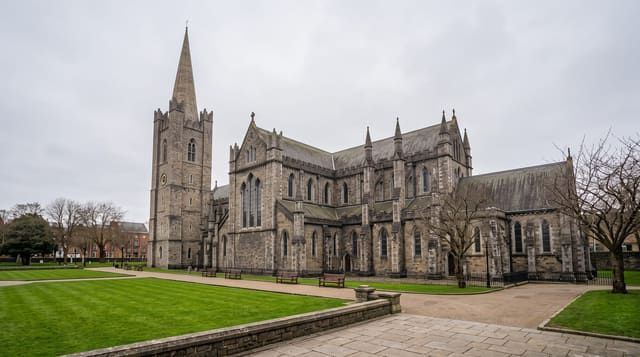
Panensky Tynec
A Gothic church left roofless and unfinished for six centuries, its walls open to the sky by accident.
Updated 19 October 2026
The Clares' convent church at Panensky Tynec was begun in the early fourteenth century on a scale far beyond what the village could support - a large aisled Gothic church with tall windows and slender piers, in the refined manner of the Prague court workshops. Building stopped, probably during the Hussite wars, with the walls and window tracery up but no vault and no roof, and it was never resumed. It has stood open ever since: six hundred years of walls, arcades and traceried windows with grass on the floor and the sky above, which is an effect no complete church produces. Local tradition attaches a reputation for unusual energy or calm to the interior and people sit in it for that; the claims about ley lines and healing are folklore rather than anything demonstrated. The convent buildings alongside are partly ruined and the village is small.
History
The settlement was first called Týnec, a diminutive of the Old Czech týn, a fortified settlement, and in the 18th century it was renamed Panenský Týnec, "Virgin Týnec", after the local abbey. It is first mentioned in 1115, as a village of the monastery of Kladruby, and sometime between 1239 and 1250 it was rebuilt as a fortified market town. The Žirotín family founded the abbey of the Order of Saint Clare in 1321; the market town burned in 1382 but soon recovered, and the Žirotíns held it until 1464, when the Lobkowicz family acquired the estate. The town suffered greatly in the Thirty Years' War, the damaged abbey was reconstructed in 1636 and served until it was abolished in 1782, the town began to grow beyond its walls between 1727 and 1785, and its gates were demolished in 1799 when the imperial road was built (Wikipedia, Panenský Týnec).
What you'll find
- A roofless Gothic church - walls, arcades and tracery standing without a vault.
- Building stopped in the 1400s - probably during the Hussite wars, never resumed.
- Court-workshop detail - tall windows and slender piers of Prague quality.
- Grass floor, open sky - six centuries of weather inside the walls.
When to go
April to October. Two hours.
Practical notes
There is nothing under cover and no facilities beyond a ticket hut. The energy and healing claims are folklore, not established fact. Seasonal opening. The village has very little else.
Nearby
Louny is fifteen kilometres north; Slany is east.
What to pack for Panensky Tynec
Chosen from what this place is for. Tap a kit for the full checklist.
- Comfortable walking shoes - Sightseeing means kilometres of pavement and cobbles daily. Find on Amazon
- Modest clothing - Shoulders and knees covered - the single most common requirement. Find on Amazon
- Shelter suited to the place - Tent, tarp or hut booking - match it to the terrain and rules. Find on Amazon
- A slim anti-theft daypack - Zips that close properly; keep it in front in crowds and on transit. Find on Amazon
Some links on this page are Amazon affiliate links - if you buy through them we may earn a small commission at no extra cost to you.
All packing kitsPlan your trip
Where to start if Panensky Tynec is going on the list.
Booking links on this page are affiliate links - if you book through them we may earn a small commission at no extra cost to you. It never changes what we write about a place.
Opening times, ticket prices and seasonal closures change - check the official source before you go: official site.