Nelahozeves Castle
A Renaissance castle holding the Lobkowicz picture collection, in the village where Dvorak was born.
Updated 19 October 2026
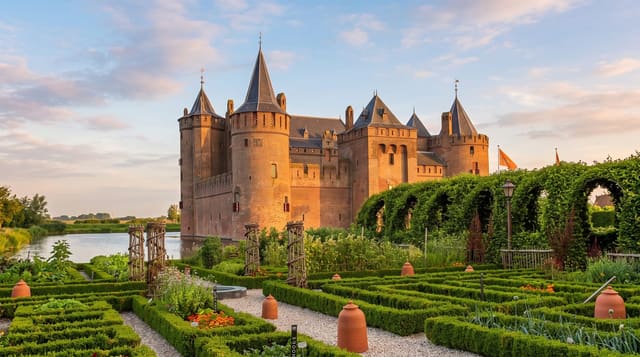
Nelahozeves was begun in 1553 for Florian Griespek of Griespach as a Renaissance castle above the Vltava, its facades covered in diamond-point sgraffito, and it passed to the Lobkowicz family in the seventeenth century. It is theirs again after restitution and it holds a substantial part of their collection - one of the largest private art holdings in Central Europe, with paintings by Cranach, Brueghel the Elder, Velazquez and Canaletto, along with arms, ceramics and a very important music archive containing manuscripts annotated by Beethoven and original parts for works the family commissioned. In the village below stands the small house where Antonin Dvorak was born in 1841, now a museum with his family's rooms and material on his early life. The two together make the visit: a magnate collection and a butcher's son's birthplace a few hundred metres apart.
History
The village name comes from Nelahoda, its probable founder, and Nelahozeves is first mentioned in 1352, when the Church of Saint Andrew already stood; it belonged to the royal chamber, then to the Metropolitan Chapter of Saint Vitus, and after the Hussite Wars again to the Czech kings. In 1544 Florian Griesbeck of Griesbach acquired it and began building the castle in 1553, and his son Blažej completed it in its final form in 1613. When Blažej died in 1620 he left the estate in debt, and Polyxena of Lobkowicz bought it in 1623. The estate suffered in the Thirty Years' War but recovered in the second half of the 17th century, and Václav Eusebius Lobkowicz reconstructed the castle as the centre for administering his estates, though it never served as the family's residence. The railway came in 1850, and the village is also known as the birthplace of the composer Antonín Dvořák (Wikipedia, Nelahozeves).
The main sights
- Diamond-point sgraffito - covering the Renaissance facades of the 1550s.
- The Lobkowicz collection - Cranach, Brueghel, Velazquez and Canaletto among it.
- A music archive - manuscripts annotated by Beethoven, and commissioned parts.
- Dvorak's birthplace - the small house in the village, now a museum.
When to go
April to October. Half a day.
Good to know
The castle and the Dvorak house are separate tickets and separate opening hours; the birthplace closes on Mondays and Tuesdays. Parts of the collection rotate to Prague. The village is small.
Nearby
Veltrusy chateau is downstream; Melnik is north.
What to pack for Nelahozeves Castle
Chosen from what this place is for. Tap a kit for the full checklist.
- Comfortable walking shoes - Sightseeing means kilometres of pavement and cobbles daily. Find on Amazon
- A slim anti-theft daypack - Zips that close properly; keep it in front in crowds and on transit. Find on Amazon
- A refillable water bottle - Many cities have public fountains; save money and plastic. Find on Amazon
- A light layer + compact umbrella - For museum air-con and a sudden shower. Find on Amazon
Some links on this page are Amazon affiliate links - if you buy through them we may earn a small commission at no extra cost to you.
All packing kitsPlan your trip
Where to start if Nelahozeves Castle is going on the list.
Booking links on this page are affiliate links - if you book through them we may earn a small commission at no extra cost to you. It never changes what we write about a place.
Opening times, ticket prices and seasonal closures change - check the official source before you go: official site.