Kuks
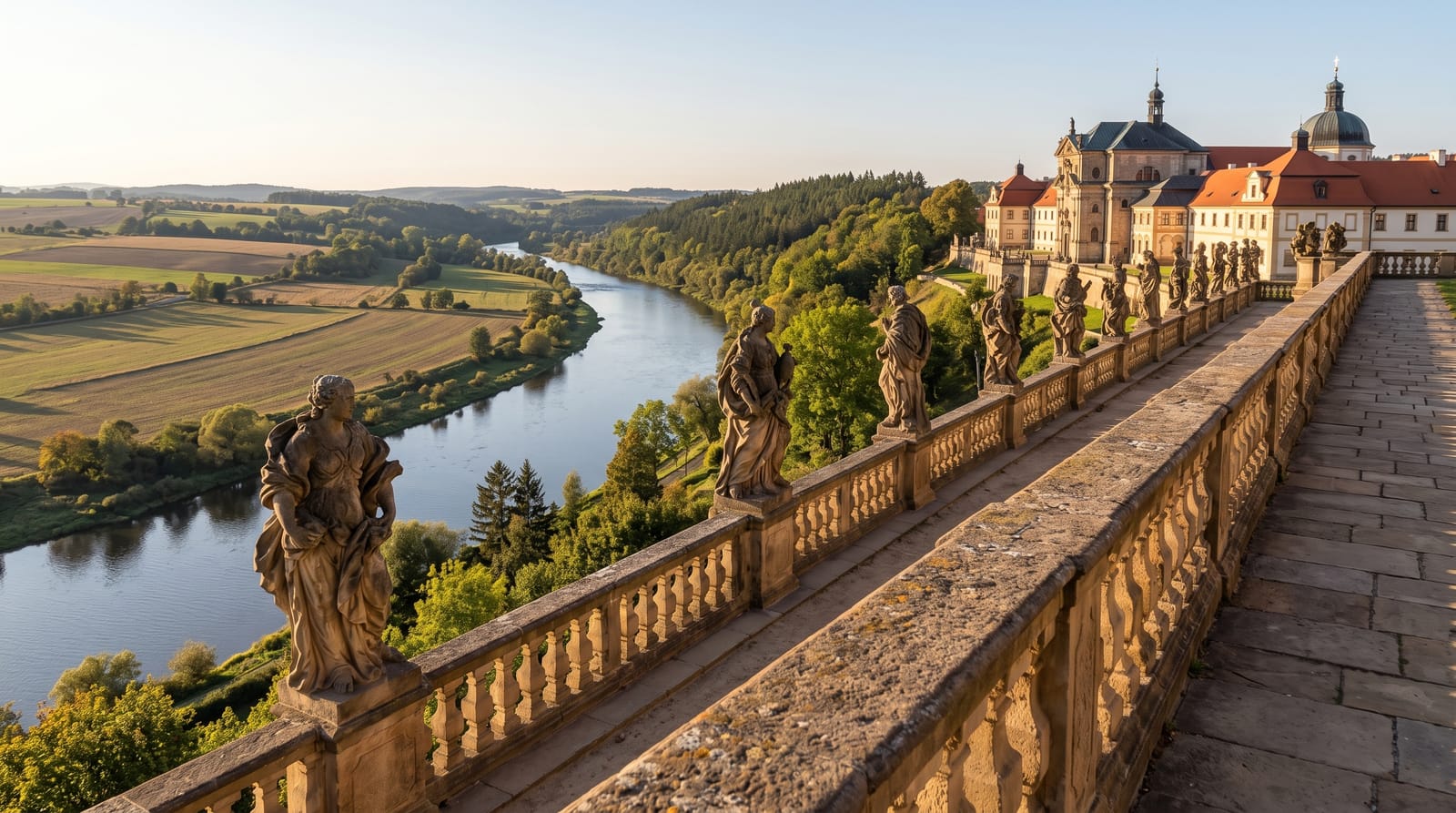
A baroque hospital terrace above the Elbe lined with allegorical statues of the Virtues and Vices carved by Matyas Braun.
Updated 19 October 2026
AI illustration
Kuks was conceived in the early 18th century by a wealthy count as a spa and estate on both banks of the Elbe, with a hospital and church on one side and bath buildings on the other. Flooding destroyed most of the spa half, and what survives is the terrace: a long baroque range above the river, its balustrade lined by stone figures. These are the reason to come. Matyas Braun carved a sequence of allegorical Virtues and Vices, faces contorted or serene, each one labelled, standing in a row that reads like an argument in stone. Inside are a church with a crypt and an early pharmacy kept with its original cabinets, jars and equipment.
History
Before any settlement existed, the area was used for gold panning, and the name probably comes from an Old German word for a share of mining revenue. Count Franz Anton von Sporck acquired the estate in 1684, and in 1692-1696 he gathered three of the mineral springs on the Elbe slope into one place and built a simple spa, then enlarged it when professors of the Charles-Ferdinand University and experts from Baden-Baden confirmed the healing effects of the water; the village grew up after the spa. He built the Chapel of the Assumption in 1696 and a chateau in front of it in 1710, and in 1707-1715 the hospital and the Church of the Holy Trinity with its crypt went up, decorated inside and out with sculpture by Matthias Braun, most famously the Virtues and Vices, with a garden behind the hospital and a cemetery closing the complex. After Sporck died in 1738 his heirs did not keep up the spa, a flood in 1740 destroyed most of it and ended its business, and the empty chateau burned in 1896, its ruins demolished in 1901 (Wikipedia, Kuks).
What's there
- Braun's Virtues and Vices - the row of allegorical statues along the hospital terrace balustrade.
- The hospital and church - the baroque range with its crypt and painted interiors.
- The historic pharmacy - original cabinets, jars and laboratory equipment kept in place.
- Braun's Bethlehem - sculptures carved directly into sandstone outcrops in the woods nearby.
When to go
April to October, when the hospital tours run and the forest walk to Braun's Bethlehem is comfortable; the site closes or reduces heavily in winter. Low side light in the morning or late afternoon gives the statues far more depth than flat midday sun does. Tours are timed, so arrive with some margin.
Before you go
The statues on the terrace are copies, with the weathered originals kept indoors, which some visitors only discover on arrival. Half the original complex is gone, so the intended layout is hard to read on the ground. Braun's Bethlehem is a three-kilometre walk each way and the carvings there are badly eroded.
Nearby
Dvur Kralove and its safari park are close by, and Hradec Kralove lies half an hour south.
What to pack for Kuks
Chosen from what this place is for. Tap a kit for the full checklist.
- Binoculars - The single best wildlife tool - even a compact pair transforms a sighting. Find on Amazon
- Comfortable walking shoes - Sightseeing means kilometres of pavement and cobbles daily. Find on Amazon
- A zoom camera or long lens - Animals rarely come close; reach beats megapixels. Find on Amazon
- A slim anti-theft daypack - Zips that close properly; keep it in front in crowds and on transit. Find on Amazon
Some links on this page are Amazon affiliate links - if you buy through them we may earn a small commission at no extra cost to you.
All packing kitsPlan your trip
Where to start if Kuks is going on the list.
Booking links on this page are affiliate links - if you book through them we may earn a small commission at no extra cost to you. It never changes what we write about a place.
Opening times, ticket prices and seasonal closures change - check the official source before you go: official site.