Korčula
A walled town laid out like a fish skeleton to break the wind, on a green island of vineyards, olives and a sword dance still performed after five centuries.
Updated 19 October 2026
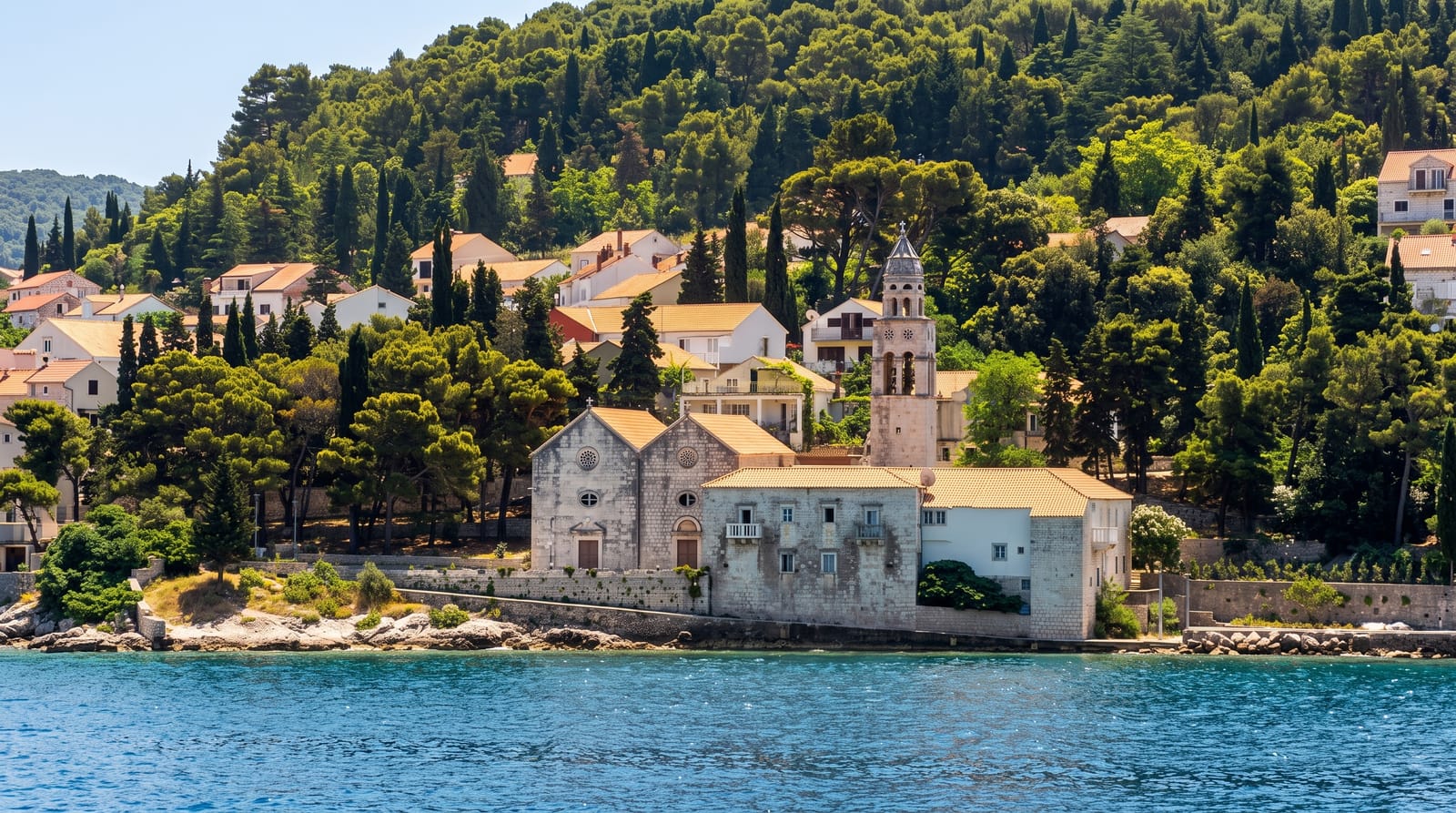
AI illustration
Korčula town sits on a small peninsula behind medieval walls, and its street plan is the thing to notice first: a central spine with ribs running off it, angled so that the streets on the eastern side are straight to let the cooling maestral through, while those on the west are curved to block the cold bura. It is a herringbone built for weather, and it works. The island beyond is one of the greenest in the Adriatic, dense with Aleppo pine, olive groves and the vineyards that produce Pošip and Grk white wines around Čara and Lumbarda. Korčula also claims Marco Polo as a native son, a claim that is disputed by historians and enthusiastically maintained locally, and the town keeps up the Moreška, a sword dance in which two armies fight over a captured princess, performed here since at least the sixteenth century.
History
Legend gives Korčula a Trojan founder, Aeneas or his friend Antenor, but the first people here were Mesolithic and Neolithic, known from the caves of Vela Spila and Jakas near Žrnovo; Illyrians followed around 1,000 BC and left stone hillforts across the island. Greek colonists from Corfu settled in the 6th century BC and called it Melaina Korkyra, "Black Korkyra", for its dense pine woods, and a stone inscription found at Lumbarda, the oldest written stone monument in Croatia, records a second colony founded by Greeks from Issa (Vis) in the 3rd century BC. After the Illyrian Wars of 220-219 BC the island became part of the Roman province of Illyricum, Roman villas spread over it, and from 10 AD it belonged to the province of Dalmatia. It came under Byzantium in the 6th century, and the Croats who settled it in the following centuries were counted with the seafaring Narentines, whose ships preyed on Venetian trade (Wikipedia, Korčula).
What's there
- The herringbone streets - the wind-planned medieval layout, best understood from the town walls.
- St Mark's Cathedral - Gothic and Renaissance stonework, with a tower climb over the roofs.
- The Moreška sword dance - performed through the summer season in the old town.
- Lumbarda and the vineyards - sandy beaches and the Grk wine villages at the island's eastern end.
When to go
May to early July and September for warm sea and moderate crowds. The Moreška runs through the summer season. Winter is very quiet, with most restaurants closed and reduced ferries.
Things to know
The Marco Polo connection is contested and the house presented as his birthplace is not established as such; enjoy it as local tradition rather than history. Korčula town is small and takes the full weight of day boats in August. Getting between the island's villages without a car is slow, and the good beaches are outside the town.
Nearby
The Pelješac peninsula and its red wine villages are a short ferry away; Mljet and Hvar are both within reach.
Key facts
Source: Wikidata, item Q13288, read on 18 October 2026.
What to pack for Korčula
Chosen from what this place is for. Tap a kit for the full checklist.
- Reef-safe sunscreen - High SPF that will not bleach the coral you are swimming over. Find on Amazon
- Head torch + spare batteries - Hands-free light is essential; caves are truly dark. Find on Amazon
- Modest clothing - Shoulders and knees covered - the single most common requirement. Find on Amazon
- Quick-dry towel - A microfibre towel packs small and dries in minutes. Find on Amazon
Some links on this page are Amazon affiliate links - if you buy through them we may earn a small commission at no extra cost to you.
All packing kitsPlan your trip
Where to start if Korčula is going on the list.
Booking links on this page are affiliate links - if you book through them we may earn a small commission at no extra cost to you. It never changes what we write about a place.
Opening times, ticket prices and seasonal closures change - check the official source before you go: official site.