The Salt Cathedral of Zipaquirá
A working church carved almost two hundred metres underground inside a salt mine, its nave cut from rock salt and lit in shifting colour.
Updated 21 October 2026
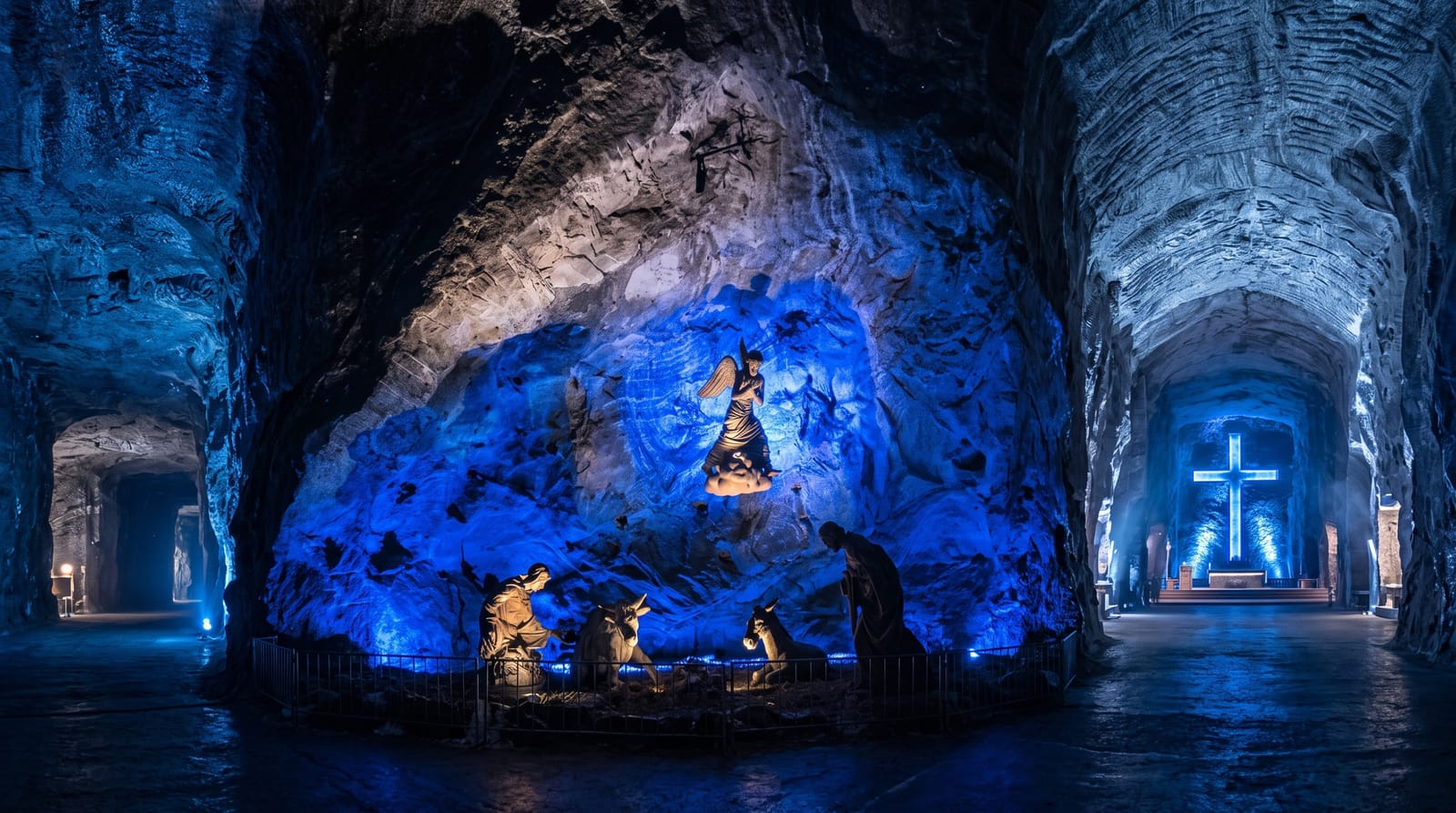
AI illustration
Salt has been mined at Zipaquirá since long before the Spanish arrived, and miners carved a chapel underground for their own use. The present cathedral, opened in 1995 after the older one was closed for safety, sits about 200 metres below the surface in tunnels cut from halite. The route begins with fourteen stations of the cross, each a chamber with a cross carved in relief or hollowed into the rock, lit in blue, violet and amber, and ends in a main nave with a cross illuminated from behind so it appears to float. The scale is genuinely cathedral-like, the acoustics are strange and dead, and the whole thing is cool and faintly salty on the lips. Services are held on Sundays.
History
The Muisca mined the halite here from the 5th century BC, and Alexander von Humboldt, visiting in 1801, judged the deposit larger than the great salt mines of Spain, Switzerland, Poland and Tyrol. Around 1932 miners carved a sanctuary underground for their prayers before work, and from 1950 a larger Salt Cathedral was built, inaugurated on 15 August 1954 and dedicated to Our Lady of the Rosary, patron of miners, with three naves and a monumental cross; structural and safety problems in the working mine led the authorities to close it in September 1992. The architect Roswell Garavito Pearl won the competition for a new cathedral, built from 1991 below the old one in caves left by earlier mining, and it was inaugurated on 16 December 1995 (Wikipedia, Salt Cathedral of Zipaquirá).
What to look for
- The stations of the cross - fourteen carved chambers descending through the mine.
- The main nave and illuminated cross - the central chamber, lit from behind.
- The salt-cut domes - side chapels carved directly from halite.
- Zipaquirá old town - a colonial square and market above ground.
When to go
Any time; it is underground and unaffected by weather, which makes it a reliable rainy-day option from Bogotá. Sundays bring services and the largest crowds. The weekend tourist train from Bogotá is a slow but pleasant way to arrive.
Practical notes
The lighting is heavily theatrical and the effect divides people, with some finding it moving and others finding it closer to a themed attraction than a church. The guided route moves in groups and cannot be done at your own pace at busy times. It is cool underground, around 14 degrees, so bring a layer.
Nearby
Bogotá is an hour south; Guatavita lake, source of the El Dorado story, lies east.
Key facts
Source: Wikidata, item Q2565876, read on 18 October 2026.
What to pack for The Salt Cathedral of Zipaquirá
Chosen from what this place is for. Tap a kit for the full checklist.
- Head torch + spare batteries - Hands-free light is essential; caves are truly dark. Find on Amazon
- Comfortable walking shoes - Sightseeing means kilometres of pavement and cobbles daily. Find on Amazon
- Modest clothing - Shoulders and knees covered - the single most common requirement. Find on Amazon
- Grippy closed shoes - Cave floors are wet, muddy and slick with formations. Find on Amazon
Some links on this page are Amazon affiliate links - if you buy through them we may earn a small commission at no extra cost to you.
All packing kitsPlan your trip
Where to start if The Salt Cathedral of Zipaquirá is going on the list.
Booking links on this page are affiliate links - if you book through them we may earn a small commission at no extra cost to you. It never changes what we write about a place.
Opening times, ticket prices and seasonal closures change - check the official source before you go: official site.