Mukden Palace
The early Qing palace in Shenyang, built before the dynasty took Beijing, mixing Manchu, Mongol and Chinese forms.
Updated 18 October 2026
AI illustration
UNESCO World Heritage
The Shenyang Imperial Palace was begun in 1625 by Nurhaci and completed under his son Hong Taiji, serving as the seat of the Later Jin and then the Qing before the dynasty moved to Beijing in 1644. It is much smaller than the Forbidden City, around sixty thousand square metres, but architecturally more interesting in one respect: it shows Manchu and Mongol forms before they were absorbed into Chinese imperial convention, notably the Dazheng Hall, an octagonal pavilion in tent form, flanked by ten pavilions for the banner princes in an arrangement that recalls a nomadic camp rather than a Chinese court. It was inscribed by UNESCO in 2004 as an extension of the Forbidden City listing.
History
Nurhaci, founder of the Later Jin dynasty, began the palace in 1625, his successor Hong Taiji added buildings by 1631, and the first three Qing emperors lived here until the dynasty took Beijing in 1644, after which it became a regional palace; the Qianlong Emperor enlarged it in 1780, and later Qing emperors usually stayed here for some time each year. A museum opened in the palace in 1928, and in 1955 it became the Shenyang Imperial Palace Museum. In 2004 it was added to the World Heritage List as an extension of the Imperial Palaces of the Ming and Qing Dynasties, together with the Forbidden City (Wikipedia, Mukden Palace).
What's there
- Dazheng Hall - the octagonal tent-form hall with the ten banner pavilions.
- The Manchu layout - a palace plan reflecting nomadic camp organisation.
- The Qingning Palace - Hong Taiji's residence with a shamanic altar.
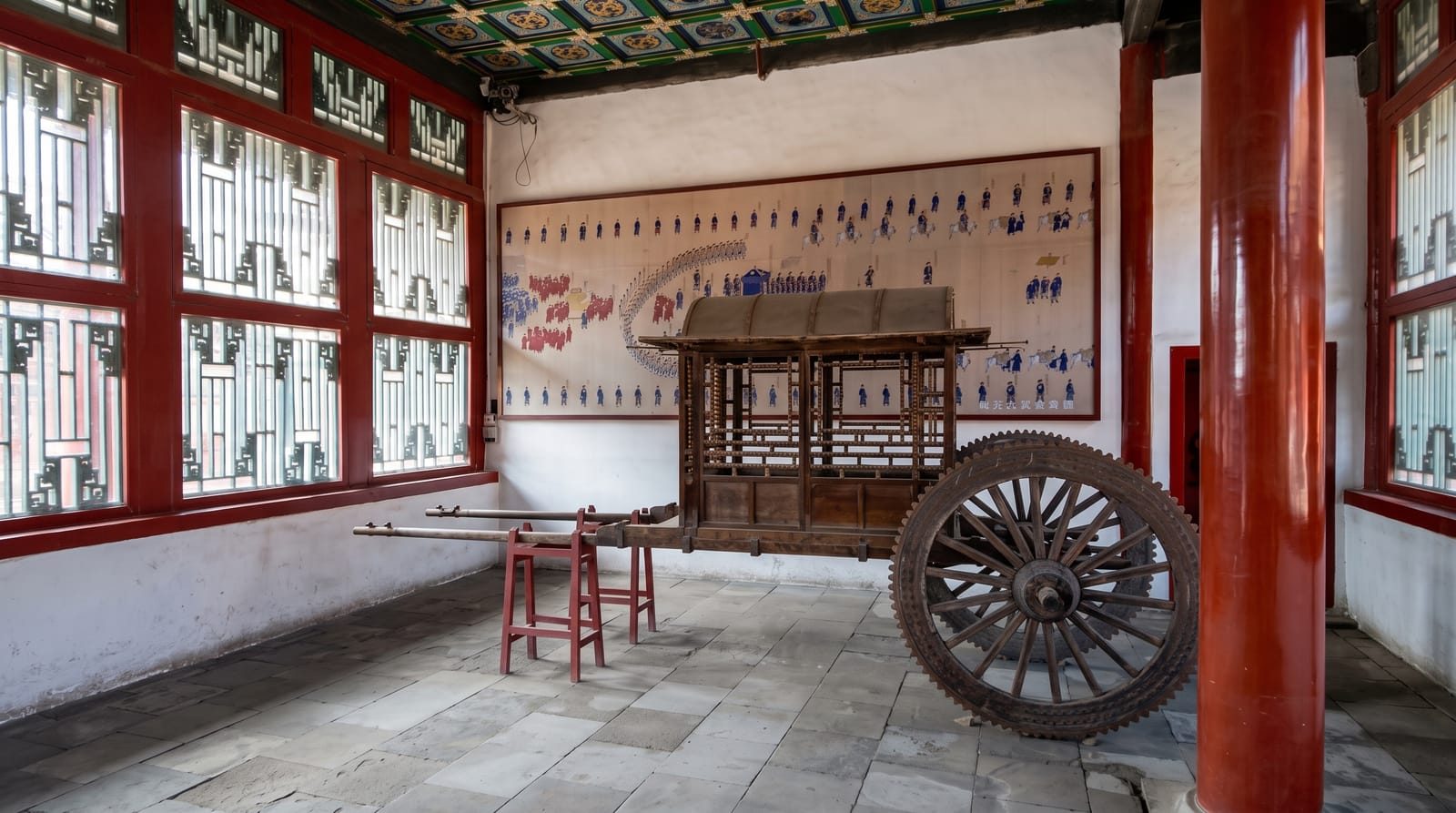
- The collections - Qing furnishings, weapons and imperial objects.
When to go
May to October; Shenyang winters are severely cold and the courtyards exposed. Weekends bring domestic visitors. The complex is compact enough for two to three hours.
What to expect
It is far smaller than Beijing's Forbidden City and visitors expecting comparable scale are disappointed. English interpretation is limited. Shenyang is an industrial city with modest tourist infrastructure.
Nearby
The Zhaoling and Fuling Qing tombs are elsewhere in the city; Qianshan lies south.
Key facts
Source: Wikidata, item Q852429, read on 18 October 2026.
What to pack for Mukden Palace
Chosen from what this place is for. Tap a kit for the full checklist.
- Comfortable walking shoes - Sightseeing means kilometres of pavement and cobbles daily. Find on Amazon
- A slim anti-theft daypack - Zips that close properly; keep it in front in crowds and on transit. Find on Amazon
- A refillable water bottle - Many cities have public fountains; save money and plastic. Find on Amazon
- A light layer + compact umbrella - For museum air-con and a sudden shower. Find on Amazon
Some links on this page are Amazon affiliate links - if you buy through them we may earn a small commission at no extra cost to you.
All packing kitsPlan your trip
Where to start if Mukden Palace is going on the list.
Booking links on this page are affiliate links - if you book through them we may earn a small commission at no extra cost to you. It never changes what we write about a place.
Opening times, ticket prices and seasonal closures change - check the official source before you go: official site.