Vegreville Pysanka
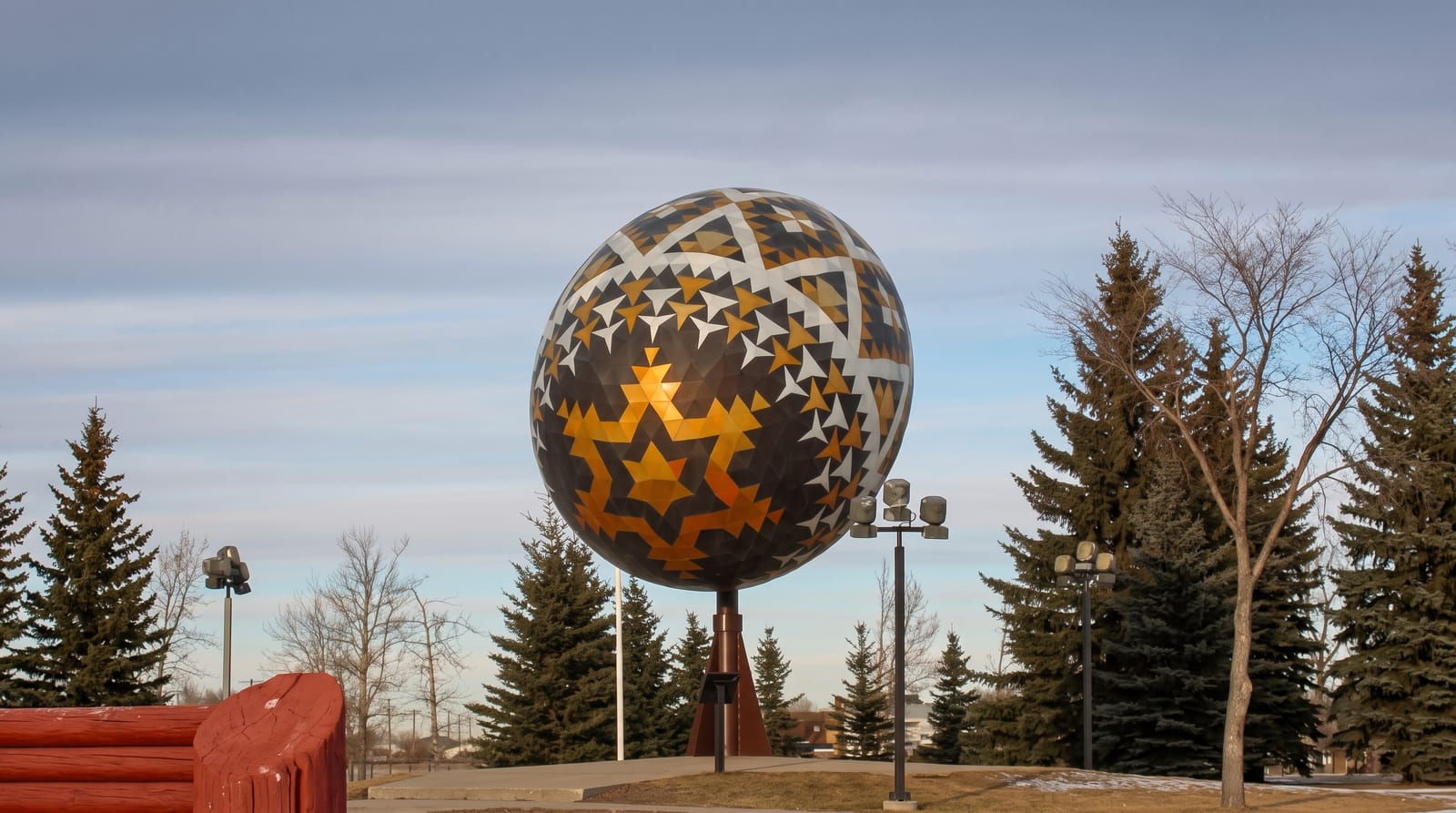
A nine-metre aluminium Easter egg, the first physical structure designed with computer modelling.
Updated 21 October 2026
AI illustration
Vegreville built this in 1975 to mark the centennial of the Royal Canadian Mounted Police and to honour the district's Ukrainian settlers, and the engineering turned out to be a landmark in its own right. A pysanka is a wax-resist decorated Easter egg, and translating the curved geometric pattern onto a three-dimensional shell of more than sixteen hundred aluminium tiles, triangles and three-pointed stars, was beyond hand calculation; Ronald Resch, a computer scientist at the University of Utah, solved it, and the result is generally described as the first physical structure designed using computer modelling. It is nine metres long, turns in the wind on a bearing, and weighs about two and a half tonnes.
Highlights
- The nine-metre egg - over three thousand visible aluminium facets in a geometric pattern.
- The wind bearing - the whole structure turns to face into the wind.
- The computer modelling story - the first physical structure designed this way.
- The Ukrainian pattern - a traditional pysanka design scaled to a monument.
When to go
May to September; the park around it is pleasant in summer and the Ukrainian Pysanka Festival runs in July. The egg is visible year-round from the highway.
Good to know
It is a roadside monument and takes fifteen minutes. The town is small with limited reasons to stay. Its main interest is the engineering story rather than the object itself.
Nearby
The Ukrainian Cultural Heritage Village lies west; Edmonton is beyond it.
Key facts
Source: Wikidata, item Q7918394, read on 18 October 2026.
What to pack for Vegreville Pysanka
Chosen from what this place is for. Tap a kit for the full checklist.
- Comfortable walking shoes - Sightseeing means kilometres of pavement and cobbles daily. Find on Amazon
- A slim anti-theft daypack - Zips that close properly; keep it in front in crowds and on transit. Find on Amazon
- A refillable water bottle - Many cities have public fountains; save money and plastic. Find on Amazon
- A light layer + compact umbrella - For museum air-con and a sudden shower. Find on Amazon
Some links on this page are Amazon affiliate links - if you buy through them we may earn a small commission at no extra cost to you.
All packing kitsPlan your trip
Where to start if Vegreville Pysanka is going on the list.
Booking links on this page are affiliate links - if you book through them we may earn a small commission at no extra cost to you. It never changes what we write about a place.
Opening times, ticket prices and seasonal closures change - check the official source before you go: official site.