Banteay Chhmar
A vast collapsed temple with face towers in the remote northwest, visited by very few and run by the local community.
Updated 19 October 2026
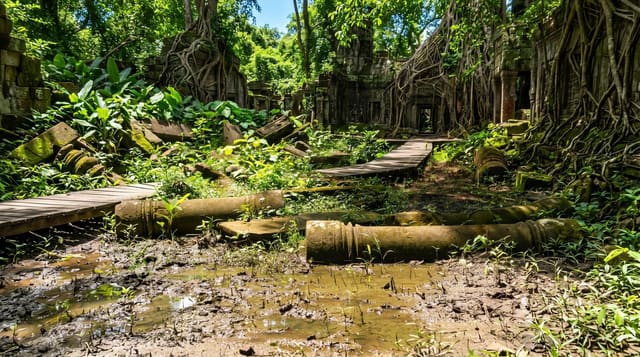
Banteay Chhmar is one of the largest temples Jayavarman VII built, a complex of nearly two square kilometres enclosed by a moat, with face towers like the Bayon and galleries of bas-relief showing battles and daily life. Almost all of it has collapsed, so it is a field of tumbled sandstone with sections standing, and walking it means picking a way over blocks. Its most celebrated feature is a relief of a multi-armed Avalokiteshvara on the western wall; part of that wall was cut out and stolen in 1998 and later recovered. A community-based tourism group runs homestays, guides and meals in the village, which is the practical way to visit. Restoration is proceeding slowly and the site is on the tentative list for World Heritage status.
History
Banteay Chhmar was built by Jayavarman VII and flourished in the 12th and 13th centuries, in the Bayon style developed under him, as one of the urban centres that grew up in the north-west of the Khmer lands. Unlike other Angkorian towns it stands in a dry outlying region and has no formal grid, so its purpose is still debated, with military, religious, political and medical roles all proposed, and airborne laser scanning has recently mapped its wider layout (Wikipedia, Banteay Chhmar).
What to look for
- Collapsed galleries - a vast field of tumbled sandstone with standing sections.
- Face towers - Bayon-style faces among the ruins.
- The Avalokiteshvara wall - the multi-armed relief on the western enclosure.
- Community homestays - village accommodation and guiding.
When to go
November to March for the roads and cooler weather. The site is open all year but the tracks around it are muddy in the rains. Visits are arranged through the community group.
Practical notes
Walking the temple means scrambling over unstable blocks, and much of it is impassable. Facilities are village homestays with basic conditions. It is a long drive from Siem Reap, three hours or more each way. There is little interpretation on site.
Nearby
Sisophon lies south; the Thai border is north.
What to pack for Banteay Chhmar
Chosen from what this place is for. Tap a kit for the full checklist.
- Comfortable walking shoes - Sightseeing means kilometres of pavement and cobbles daily. Find on Amazon
- Modest clothing - Shoulders and knees covered - the single most common requirement. Find on Amazon
- A slim anti-theft daypack - Zips that close properly; keep it in front in crowds and on transit. Find on Amazon
- A scarf or shawl - To cover the head or shoulders on entry; women especially at mosques. Find on Amazon
Some links on this page are Amazon affiliate links - if you buy through them we may earn a small commission at no extra cost to you.
All packing kitsPlan your trip
Where to start if Banteay Chhmar is going on the list.
Booking links on this page are affiliate links - if you book through them we may earn a small commission at no extra cost to you. It never changes what we write about a place.
Opening times, ticket prices and seasonal closures change - check the official source before you go: official site.