The Legend of the Northern Lights
Foxes of fire, restless ancestors and a bridge of light - what the peoples of the north believed the aurora was, and where you can stand under it yourself.

AI illustration.
Some links on this page are Amazon affiliate links - if you buy through them we may earn a small commission at no extra cost to you.
Before anyone knew about solar wind and magnetic fields, the people who lived under the northern lights had to explain them somehow. Their answers are some of the most beautiful stories ever told about the sky.
The fox that sets the sky on fire
In Finland the aurora is called revontulet, literally "fox fires". The old tale says an Arctic fox runs so fast across the fells of Lapland that its tail sweeps snow into the sky, and the crystals catch fire as they rise. Another version has the fox's tail striking sparks straight off the mountains. Either way, the fox is never seen, only the blaze it leaves behind.
Ancestors, omens and respect
For the Sami, the indigenous people of northern Scandinavia, the lights were something to treat carefully. Many families taught that the aurora carried the souls of the departed, and that you should not whistle, sing or wave at it, in case it came down for you. Some still keep the custom today, and standing in the silence of a Lapland night, it is easy to understand why.
The Norse looked up and saw something else again: the glint of armour. One later tradition links the lights to the Valkyries riding across the sky, their shields throwing light as they carried the fallen to Valhalla. Others called the glow the Bifrost, the burning bridge between the world of men and the world of the gods.
Whales, swans and dancing spirits
The stories stretch right around the pole. Some Inuit groups described the lights as spirits playing ball with a walrus skull. In Estonia they were wedding horses. A Danish folk tale blames swans that flew too far north and got caught in the ice, flapping their wings and throwing light. Almost every northern people found their own way to say the same thing: the sky is alive tonight.
What is actually happening
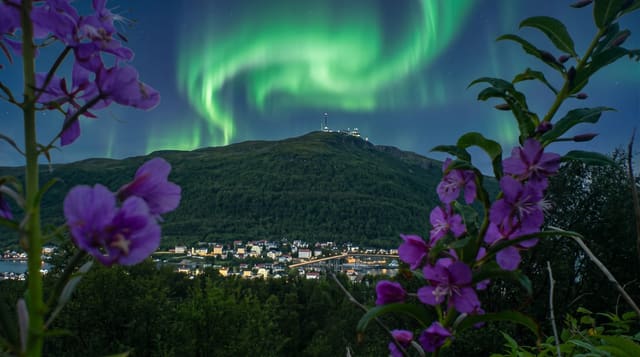
The modern answer is charged particles from the sun colliding with gases high in the atmosphere, guided towards the poles by the earth's magnetic field. Oxygen burns green and red, nitrogen adds blue and violet. It is physics, but on a clear night above the Arctic Circle it does not feel like physics.
Where to stand under them
- Aurora season in Lapland - the classic fox-fire country of northern Finland, with some of the most reliable displays anywhere.
- The Tromso cable car - ride above the city lights of Norway's aurora capital for a grandstand view.
- Kirkjufell - Iceland's most photographed mountain is at its best with green light curling behind it.
Packing for an aurora night
Aurora watching is mostly standing still in serious cold, so dress like it: proper insulated layers and warmers first, then the camera. A tripod and spare batteries matter more than an expensive lens, because the cold eats charge fast. A simple thermos flask of something hot is the difference between giving up at midnight and seeing the show at one.
The lights rarely arrive on schedule. The old stories got that part right: the fox runs when it wants to.
When to go and how long
- Aurora Hunting in Lapland Finland Best season September to March, on clear dark nights Time to allow Evenings across a stay
- Fjellheisen Tromso Norway Best season Year-round; winter for aurora, summer for midnight sun Time to allow One to two hours
- Kirkjufell Iceland Best season Year-round; winter for aurora Time to allow One to two hours
Taken from each place page, where opening rules and the official link are kept.