Lida Castle
A fourteenth-century brick and stone castle in Lida, one of the earliest of its type, heavily restored.
Updated 18 October 2026
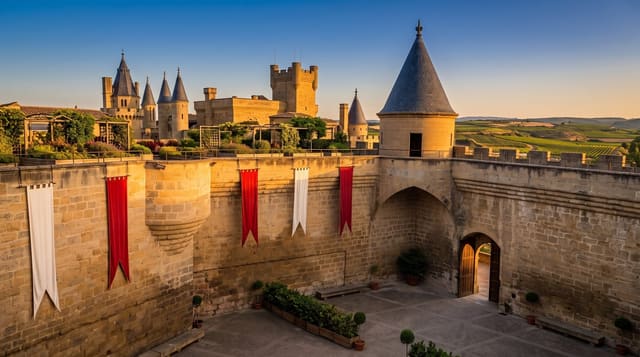
Lida castle was built in the 1320s under Grand Duke Gediminas as part of a line of strongholds against Teutonic incursions, a rectangular enclosure of fieldstone and brick with two corner towers, raised on an artificial mound between two rivers. It was besieged repeatedly and fell into ruin after the eighteenth century, with the towers collapsing and stone taken for building. Restoration from the 1980s onward rebuilt the walls and both towers, so what stands is largely modern work on medieval foundations. The interior holds a museum, workshops and event space, and knightly tournaments and festivals are staged in the courtyard through the summer.
History
Grand Duke Gediminas built the castle in the early 14th century as one of a chain of fortresses defending Lithuania against the Teutonic Knights, on a site guarded by the Kamenka and Lida rivers, with boulder walls raised in 1323, 1324 and 1325 and later faced with red brick; the town of Lida grew up around it. The Teutonic Knights took it in 1384 and 1392, Vytautas gave it to his ally Khan Tokhtamysh, who lived in a yurt near the castle, the family of Yury of Smolensk was held hostage here in 1406, and in 1433 it was fought over by Švitrigaila and Sigismund Kęstutaitis; its church was moved outside the walls in 1533 (Wikipedia, Lida Castle).
The main sights
- The rebuilt walls and towers - the restored enclosure and its corners.
- The courtyard - the interior used for events and displays.
- The museum - the exhibition on the castle and the region.
- Summer tournaments - the staged medieval events in season.
When to go
May to September, when the courtyard events run and the towers are open; winter hours are reduced. Festivals fill the castle on particular weekends. Weekday mornings are quiet.
Practical notes
Most of what stands is modern reconstruction rather than medieval fabric. The museum is small. Event weekends change the character considerably. The castle sits in a modern town centre with no historic surroundings.
Nearby
Novogrudok lies southeast; Grodno is west.
Key facts
Source: Wikidata, item Q2634748, read on 18 October 2026.
What to pack for Lida Castle
Chosen from what this place is for. Tap a kit for the full checklist.
- Comfortable walking shoes - Sightseeing means kilometres of pavement and cobbles daily. Find on Amazon
- A slim anti-theft daypack - Zips that close properly; keep it in front in crowds and on transit. Find on Amazon
- A refillable water bottle - Many cities have public fountains; save money and plastic. Find on Amazon
- A light layer + compact umbrella - For museum air-con and a sudden shower. Find on Amazon
Some links on this page are Amazon affiliate links - if you buy through them we may earn a small commission at no extra cost to you.
All packing kitsPlan your trip
Where to start if Lida Castle is going on the list.
Booking links on this page are affiliate links - if you book through them we may earn a small commission at no extra cost to you. It never changes what we write about a place.
Opening times, ticket prices and seasonal closures change - check the official source before you go: official site.