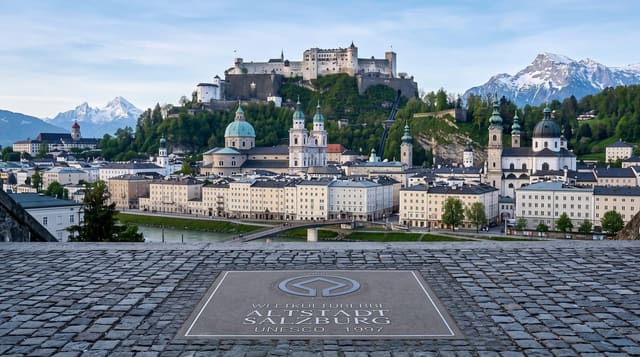
Hohensalzburg Fortress
One of the largest surviving medieval fortresses in Europe, sitting on the ridge above Salzburg with the old town spread below.
Updated 18 October 2026
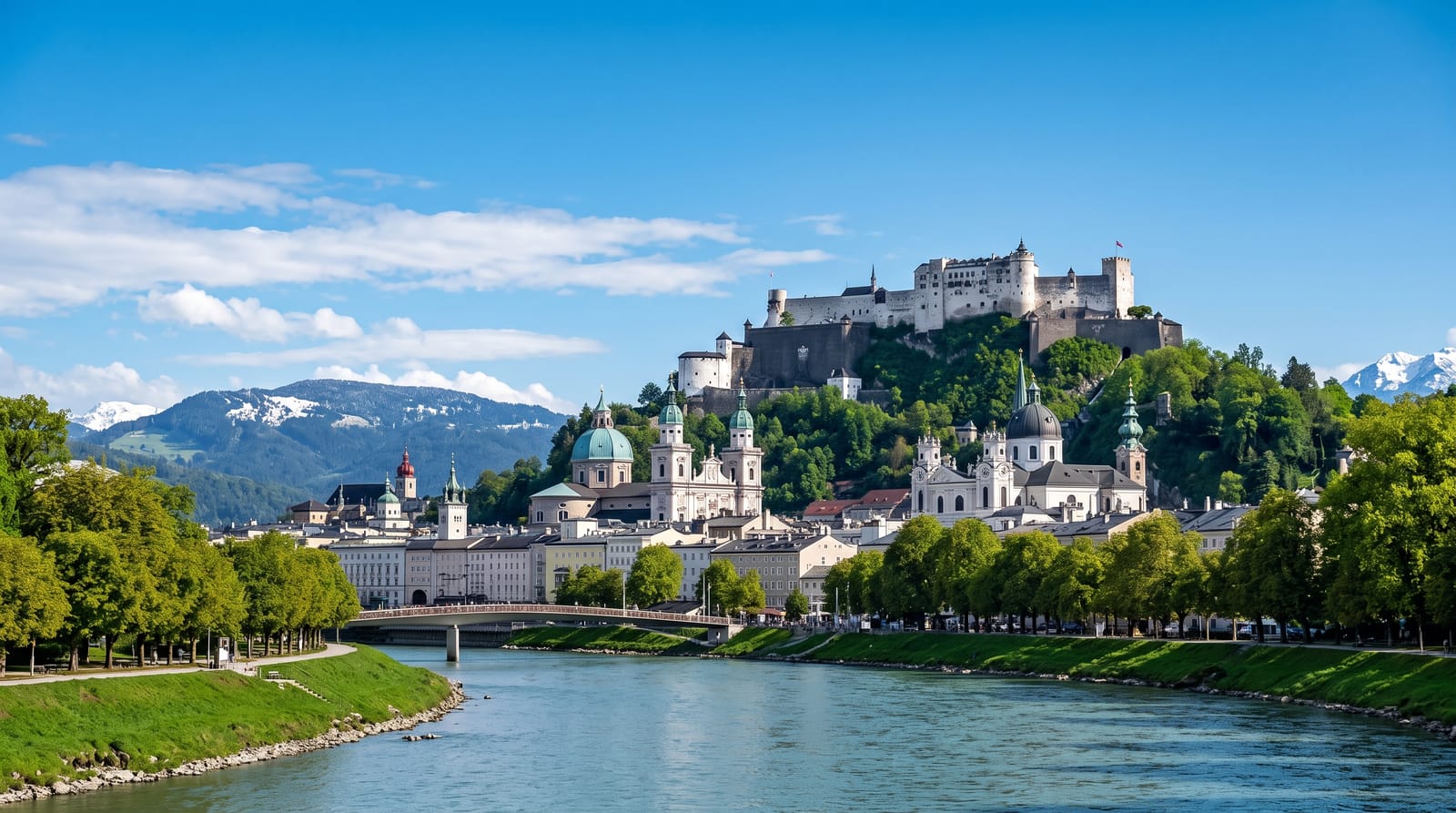
AI illustration
The fortress on the Festungsberg was begun in 1077 by the archbishops of Salzburg and kept growing for six centuries, which is why it survives more or less intact rather than as a ruin. Inside the walls you get a small town: courtyards, a chapel, cisterns, storerooms and the late Gothic state rooms the archbishops used. The Golden Hall keeps its painted ceiling studded with gilt bosses, and the neighbouring chamber has a tiled stove worth the climb on its own. The ramparts give the view that ends up on every postcard of Salzburg: domes, the Salzach, and the Untersberg closing the horizon to the south.
History
Digs have found a Roman fort on the highest point of the hill, and the present fortress was begun in 1077 under Archbishop Gebhard as a simple bailey with a wooden wall, enlarged because of his conflict with Emperor Henry IV in the Investiture Controversy and steadily over the centuries after. Prince-Archbishop Burkhard II von Weißpriach built the ring walls and towers in 1462, Leonhard von Keutschach expanded the fortress again between 1495 and 1519, and in 1515 his coadjutor Matthäus Lang described the Reisszug, a very early funicular for goods to the upper courtyard; restored from the late 19th century, it became a great attraction once the Festungsbahn funicular opened in 1892 (Wikipedia, Hohensalzburg Fortress).
The main sights
- The Golden Hall and Golden Chamber - the late Gothic state rooms with a starred ceiling and a huge tiled stove.
- The ramparts - the walk around the walls, old town roofs on one side and mountains on the other.
- The fortress courtyards - a self-contained hill town of chapel, wells, workshops and storerooms.
- The Salzburg Bull - the mechanical organ in the tower, which still sounds out over the city at set times.
When to go
Open all year, and the funicular runs in most weather. Morning light suits photographs of the old town below; late afternoon is better for the mountains. Queues for the funicular are worst between eleven and three in summer and during the Advent markets. In poor weather the interiors still fill an hour or two.
Before you go
Tickets bundle the funicular with the interiors, so it is not cheap, and the audio guide route is slow when the fortress is full. The rooms open to visitors are a fraction of the complex. Much of what you walk through is bare stone rather than furnished, and on a grey day the famous view is simply grey.
Nearby
The old town, the cathedral and the Nonnberg convent are all directly below the hill.
Key facts
Source: Wikidata, item Q679292, read on 18 October 2026.
What to pack for Hohensalzburg Fortress
Chosen from what this place is for. Tap a kit for the full checklist.
- Comfortable walking shoes - Sightseeing means kilometres of pavement and cobbles daily. Find on Amazon
- Modest clothing - Shoulders and knees covered - the single most common requirement. Find on Amazon
- A slim anti-theft daypack - Zips that close properly; keep it in front in crowds and on transit. Find on Amazon
- A scarf or shawl - To cover the head or shoulders on entry; women especially at mosques. Find on Amazon
Some links on this page are Amazon affiliate links - if you buy through them we may earn a small commission at no extra cost to you.
All packing kitsPlan your trip
Where to start if Hohensalzburg Fortress is going on the list.
Booking links on this page are affiliate links - if you book through them we may earn a small commission at no extra cost to you. It never changes what we write about a place.
Opening times, ticket prices and seasonal closures change - check the official source before you go: official site.